Andyʼs working notes
About these notesLiu et al. - 2026 - Creative Reading
referenceArchiveUUID: "45a4c3ec-58db-41d6-ad1c-ea16935574c7"
fullTitle: "Creative Reading: Scaffolding Reading for Transformation"
authors: ["Sophia Liu","Sarah Abowitz","Yijun Liu","Sarah Sterman","Shm Garanganao Almeda","Max Kreminski"]
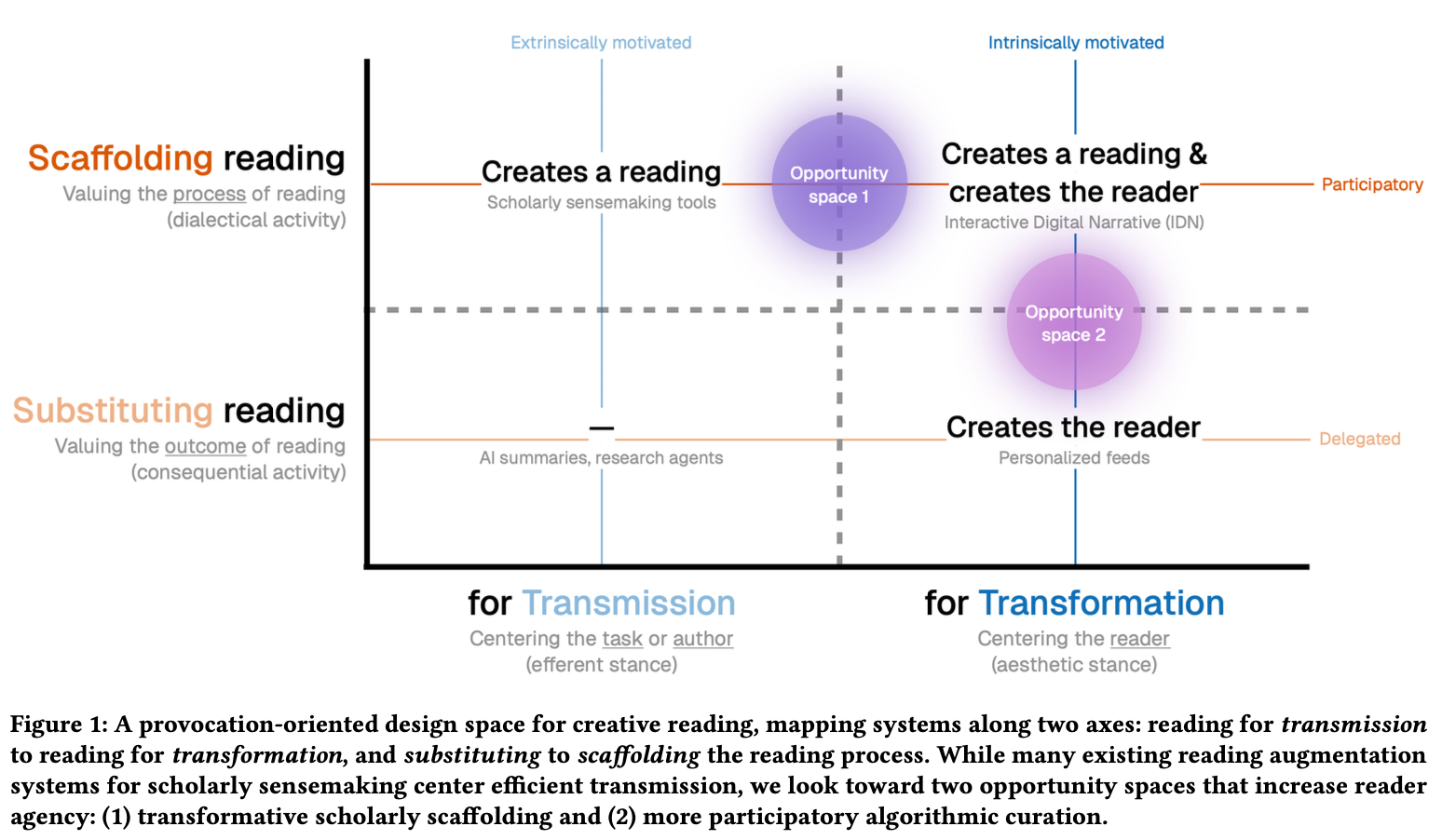
Talk of reading augmentation usually frames reading as an exercise in transmission: it’s instrumental; you’re trying to extract facts / claims from the page and put them into your head as quickly as possible (“the efferent stance”). But much reading is also aesthetic and creative: as you read, you’re constructing new questions, new ideas, a personal interpretation—and in the limit, transforming the self. The first approach centers the author or an external task; the second approach centers the reader. ==“Reading creates readings, and in doing so, creates readers.”==
The authors rightly point out that augmentation neglects the latter (e.g. Current conception of Orbit is overly memory-focused; where’s the poetry?) and propose a spectrum from “reading for transmission” to “reading for transformation.” They suggest:
Reading for transformation instead asks how systems might encourage an aesthetic stance toward reading, scaffolding changes that exceed the immediate task [Timeful text?] by shaping how readers read and think, and consequently, the questions, tastes, and sensibilities the bring to future readings and work.
A very nice definition of reading (scholarly reading, really):
the situated activity of encountering, navigating, interpreting, and relating texts, both within and across sources
vs. “readings”, the noun form:
…meaning emerges through the transaction between reader and text. We call the product of this transaction “a reading”, the interpretation or artifact created during the activity of reading.
This reminds me of something I found myself saying a lot in my collaboration with Matthew Siu: for many texts, the point of reading a text is—the success condition—is to be transformed by it. This requires active participation from the reader; per Why books don’t work, the book generally does little to help.
They also propose a spectrum for the reading process: are we substituting the reading process (which values the outcome), or are we scaffolding the reading process (which values the process of reading—the reflective flow, the good discovered from within the activity)? AI-generated summaries substitute (for transmission); sycophantic AI advice substitute (for transformation); tools like Fok et al. - 2023 - Scim|Scim scaffold (for transmission). Scaffolding for transformation is much rarer. Latticework aspired to that. LiquidText aspires to that.
For the authors, “creative reading” is this last category: “reading augmentation that supports readers in creating readings, and in creating themselves as readers.” And: “Reading becomes creative when the encounter between reader and text produces something that neither fully contains in advance.”
How might we get new tools in the last quadrant? Perhaps by shifting tools from adjacent quadrants. The authors propose two opportunity areas:
- Transformative scholarly scaffolding: tools which scaffold both efferent sensemaking and reflective flow
- Algorithmic curation as reader creation: making algorithmic feeds more scaffolded than substitutive
They also briefly treat the issue of sociality, which seems very underexplored in these systems. (E.g. Think harder about sociality and memory systems)
Reading augmentation systems should help readers “develop, trust, and give voice to their own aesthetic experiences” while bringing that plurality in relation to others
There’s a significant Timeful text/Pico
I find this paper tremendously exciting—the most exciting HCI paper I’ve read in quite some time. I’m less sure about its various formalisms (dialectical activities, process aesthetics, running shoes vs. dumbbells vs. skis) and mostly just reacting to its central call to augment the contemplative, the aesthetic, the creative elements of reading. It’s something that’s really felt missing from my work, and it’s bothered me more and more over the years. I’d like to do something about it.